 Celebrate with up to 80% off
Cyberbullying guide for parents: What to do to protect your child

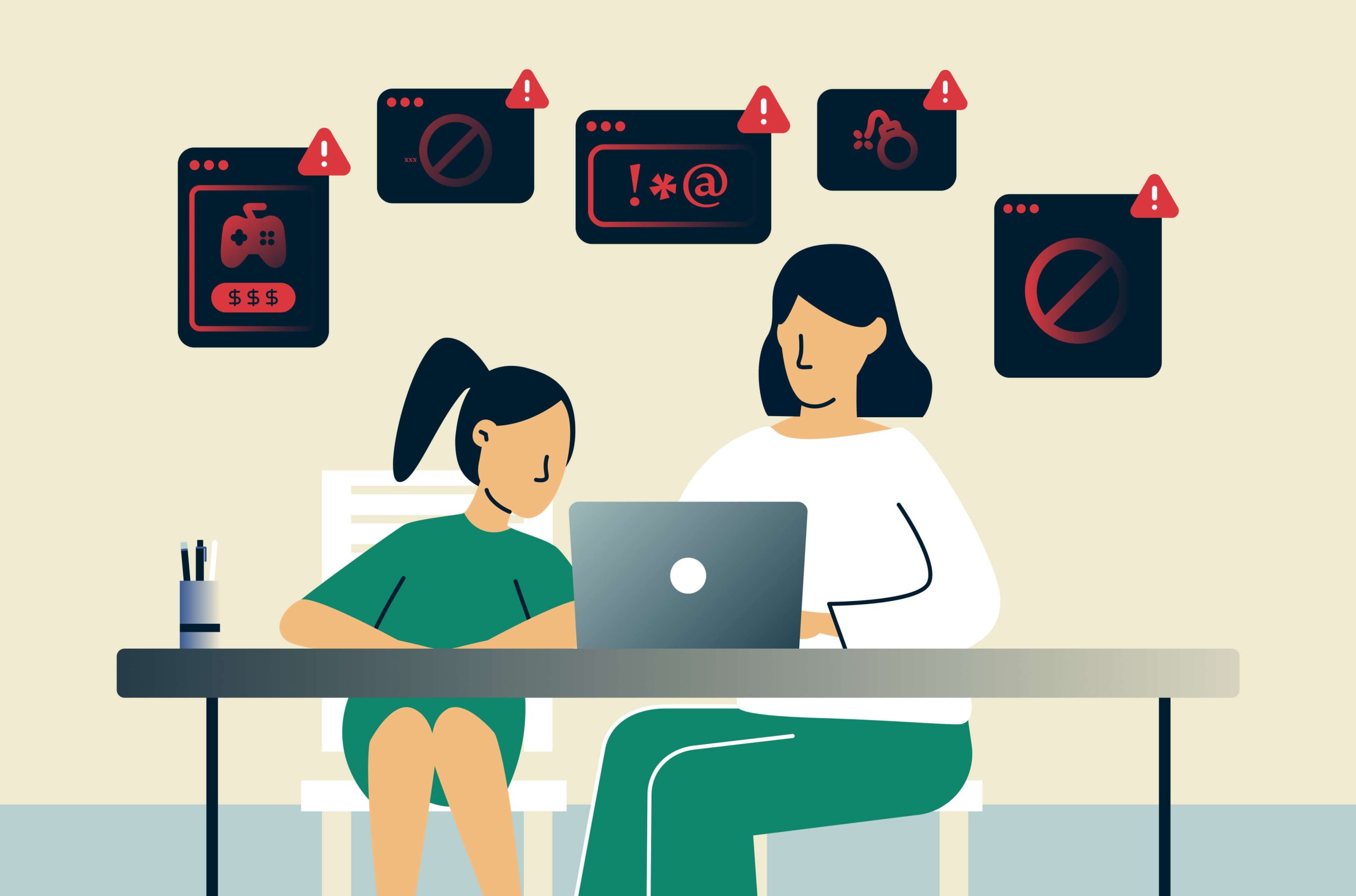
Cyberbullying has become a growing concern as more of children’s social lives move online. Messaging apps, social media, gaming platforms, and group chats help kids stay connected, but they can also become spaces where bullying thrives.
Unlike in-person bullying, which tends to be confined to certain moments and locations, online harassment can be harder to escape. Mean comments, harmful rumors, or mocking posts can still reach your child wherever they are; even in safe physical spaces, like your home.
At ExpressVPN, we aim to bridge the gap between online privacy and real-world safety. While tools like ExpressVPN can help protect your digital anonymity and secure your connection, they cannot prevent issues like cyberbullying, whose effects often extend far beyond the screen.
Addressing cyberbullying requires a human approach and active involvement. To better protect their kids, parents should stay informed, learn to recognize warning signs, and take proactive steps to address cyberbullying.
Please note: This guide is for general informational purposes only and does not constitute legal or medical advice. If your child is in immediate danger or experiencing severe emotional distress, contact local authorities or a qualified professional for support.
Understanding cyberbullying
Learning what cyberbullying is and the different forms it can take is the first step in helping your child handle online harassment. In this section, we also explore who is statistically more at risk and the potential impact cyberbullying can have.
What is cyberbullying?
Cyberbullying involves the use of digital devices (such as smartphones or computers) to intimidate, threaten, or harass someone online. Messaging apps, social media, online forums, or even emails can be used for this purpose.
Bullying, whether executed in person or through digital means, is usually driven by power imbalance. The bully typically relies on their physical strength, social status, or popularity to hurt or exert control over the victim.
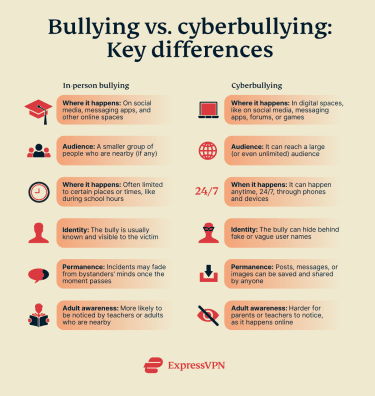
However, cyberbullying comes with a unique set of challenges that could make it more difficult to manage than in-person harassment. For instance:
- It can happen anytime: When bullying happens offline, it stops once children are not in the same room as the person targeting them. When it happens online, it can follow them 24/7 through their devices.
- It has a wider audience: Cyberbullying occurs in digital spaces, where harmful content can spread quickly and reach a much larger audience than in-person bullying.
- It is often anonymous: Cyberbullies can hide behind fake accounts or nondescript usernames, which makes it harder to identify the person responsible. Bullies often feel emboldened in anonymity and allow themselves to say or do things online that they would be unlikely to say or do in person.
- It creates a permanent digital footprint: Posts, photos, and messages can be captured and shared through screenshots. Even if the original content is deleted, cyberbullying incidents may continue to affect a person’s future, reputation, and mental well-being for a long time.
- It is harder to spot: Cyberbullying often goes unnoticed by parents and teachers because it takes place in digital spaces where they don’t typically interact with children, like on social media or gaming platforms.
What does cyberbullying look like?
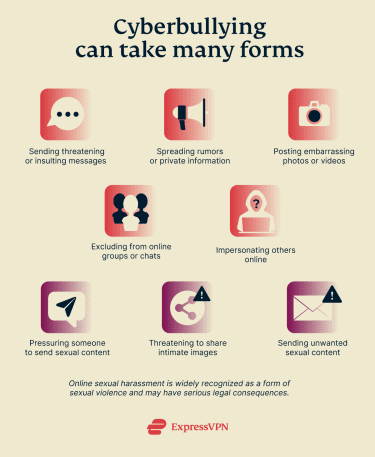
Cyberbullying may involve sending abusive messages, intentionally excluding someone from online groups, or posting private information about another person.
Here are some of the most common types of cyberbullying that children may experience.
Harassment
Harassing someone online involves repeatedly sending hurtful, threatening, or abusive messages via text, email, or social media. These messages are meant to embarrass, offend, scare, or emotionally hurt the recipient. They can be either sent in private or posted in public spaces (like social media or group chats), where many people can see the hurtful content.
The key aspect of harassment is its persistent nature. Bullies can send hundreds or even thousands of messages that insult, mock, or demean the person they’re targeting.
Outing
Outing is a form of cyberbullying in which someone shares a person’s private information online without their consent, often to humiliate or harm them. The exposed information includes details that the person would have preferred to keep private at the time (like their sexual orientation or medical history).
Outing can take many forms, like sharing screenshots of private chats, uploading personal photos or videos, or disclosing sensitive information in a public post. In extreme cases, outing can also include publishing addresses, phone numbers, or other identifying details online. This practice is known as doxxing.
Exclusion
Social exclusion is one of the most common forms of bullying in general. In the case of cyberbullying, it involves deliberately leaving someone out of online groups and chats in order to hurt, isolate, or humiliate them.
For children and teenagers, exclusion often comes down to purposefully excluding someone from a gaming community. For instance, when a child is repeatedly left out of team invites or group matches that their peers regularly join together.
Impersonation
In this case, the cyberbully pretends to be someone else online so they can anonymously harm, embarrass, or manipulate their target. There are two types of impersonation: masquerading and fraping.
When masquerading, the bully creates a fake profile (be it of a real individual or a fabricated persona) to harass, spread rumors, or post harmful content without revealing their true identity.
When fraping, the bully gains access to the victim’s social media account to post humiliating content or send inappropriate messages while pretending to be them. Onlookers, including friends and family, may believe that the inappropriate actions were carried out by the victim.
Flaming
Flaming is a type of cyberbullying where an individual sends hostile messages online to provoke a fight or emotional response from the victim.
It’s different from general online arguments in that its goal is to degrade and humiliate the victim, escalating into “flame wars” (a series of aggressive messages between two or more individuals online).
Unlike other forms of digital harassment, flaming is usually short-term and tied to a specific argument. It also tends to happen in public spaces (such as social media, forums, group chats, or gaming platforms), as the aim is to provoke or embarrass someone in front of a wider audience.
Online sexual harassment
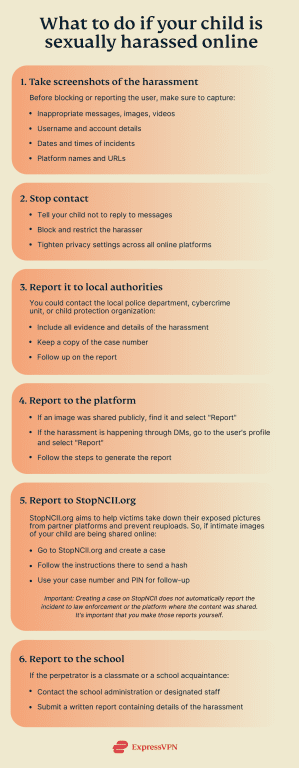
Online sexual harassment a particularly serious type of cyberbullying. It can encompass behaviors such as:
- Sending sexually charged messages to an unconsenting recipient.
- Pressuring someone to send them sexual content.
- Exposing (or threatening to expose) someone’s intimate images or videos.
- Sending unsolicited explicit content to an unconsenting recipient.
- Using AI tools to generate sexualized images of someone without their consent.
Although online sexual harassment is a form of sexual violence that can affect both genders, research consistently shows that girls are disproportionately affected. For example, the UK Safer Internet Centre found that girls are nearly three times more likely than boys to receive unwanted sexual messages online. Girls are also twice as likely to be pressured into sharing nude images.
Where’s the line between bullying and teasing?
Sometimes the line between humor and bullying can be blurry, making cyberbullying difficult to identify. Children may use terms like drama, joke, prank, or banter to describe certain interactions that cross the line into cyberbullying. These words tend to downplay the seriousness of the incident and its potential consequences.
For instance, the word “banter” technically refers to playful teasing or lighthearted joking between friends, but it can also be used to mask, justify, or mistakenly describe bullying behavior.
A study conducted in 2020 found that many teens in the UK view banter as a normal and socially accepted form of online interaction. However, they often struggle to distinguish between playful teasing and harmful behavior.
Because online communication lacks nonverbal cues, participants reported that jokes can easily be misinterpreted, and aggressive comments may be dismissed as “just banter,” even when they cause distress.
The opposite may be true as well: teasing comments may be mislabeled as “cyberbullying” even when they were not made with ill intent.
For example, a 2021 study analyzing the r/RoastMe subreddit found that roasting and cyberbullying differ in both intention and social context. While roasting involves playful, consensual humour, outsiders may deem it cyberbullying due to their own interpretation of the interaction.
Given how subtle the differences between these online behaviors can be, it’s important to remind children that their feelings matter. If something upsets your child or makes them feel uneasy, teach them to step away from the screen and discuss it with an adult.
You should refrain from encouraging your child to confront the person who made them feel uncomfortable, as there is no way of knowing how they may respond to that confrontation.
You should, however, advise your child to be mindful of how they treat others online. Remind them that, before joking or teasing others online, they should make sure the other person is comfortable with it and that their comments aren’t causing harm.
Who does cyberbullying affect most?
Cyberbullying can affect young people of all backgrounds, but certain groups tend to be at higher risk. For example, research shows that cyberbullying is particularly prevalent during early and mid-adolescence.
A Pew Research Center survey found that, in the U.S., cyberbullying was most prevalent among 15- to 17-year-olds. Around 49% of teens in this age group admitted to experiencing at least one form of online harassment, compared to 42% of 13- to 14-year-olds.
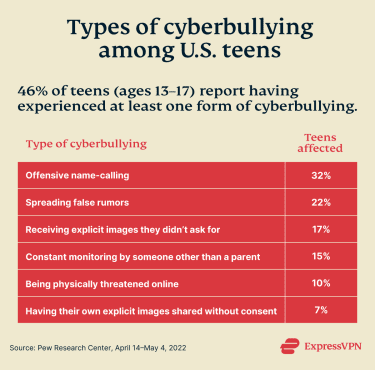
When it comes to gender, although all teens can be affected, girls are generally more likely to experience cyberbullying. Up to 59% of girls reported such experiences compared to 49% of boys. Moreover, the type of harassment experienced can also differ among genders.
Teenage girls tend to gravitate toward visual social media platforms such as Instagram, Snapchat, and TikTok. Posting photos, opinions, and personal content often exposes adolescents to public scrutiny and negative feedback, which can escalate to cyberbullying.
In contrast, boys are more likely to use entertainment and community-based platforms such as YouTube, Twitch, and Reddit. While harassment is also prevalent on these platforms, it often takes a different form. For example, verbal harassment (including insults, slurs, and other coarse interactions between players) can be common during gameplay.
When girls enter these gaming environments, they can become targets of gender-based harassment. This includes sexist remarks, sexualized comments, or having their gaming abilities constantly questioned simply because they are female.
When it comes to perpetrators, the Cyberbullying Research Center found that cyberbullies are most commonly adolescents and teens, too, though being a perpetrator is generally less common than being a victim.
Bullies tend to display lower empathy, poor emotional regulation, and higher impulsivity. Still, it’s important to note that situational factors (such as peer pressure or online anonymity) can also play an important role. So, young people without these traits may sometimes engage in abusive online behavior as well.
How can cyberbullying harm children?
Cyberbullying can have lasting negative effects on children’s emotional, mental, social, and even physical well-being if they don’t receive adequate support timely.
Here are some of the negative impacts commonly associated with cyberbullying:
- Low self-esteem: Cyberbullying often targets personal traits such as appearance, intelligence, or social standing, which may be especially sensitive topics during childhood and adolescence. Over time, demeaning comments can impact how they view their own worth.
Studies show that being bullied can reduce self-esteem, which in turn increases the likelihood of being further bullied, creating a reinforcing cycle over time. - Anxiety: Cyberbullying’s persistent nature can provoke constant stress to the victim. The fact that it often takes place in public spaces (where it can be easily seen, saved, and shared by peers) can be cause for further distress.
The public exposure may lead to embarrassment, fear of judgment, and rumination, increasing the risk of social anxiety.
Depression: Children and adolescents who are cyberbullied are also more likely to report depressive symptoms than their peers. Being repeatedly targeted online can erode their self‑confidence and make them doubt their social abilities.
Not every child who faces cyberbullying will develop depression, but repeated online harassment could potentially lead to lasting depressive symptoms. - Social isolation: Being harassed, mocked, or left out can make anyone feel deeply isolated from their peer community. Children who are cyberbullied may struggle to build confidence, participate in social activities, or feel comfortable in group settings.
Victims often withdraw from social interactions (both online and in real life) as a way to avoid further harm, which can lead to loneliness. This, in turn, can make it even harder for them to deal with the effects of cyberbullying.
Spotting cyberbullying
Cyberbullying doesn’t affect every child in the same way, but there usually are certain signs that something’s not right. When several of these appear at the same time, it may be an indication that your child is experiencing online harassment.
In this section, we’ll go over some of the behaviors commonly associated with both victims and perpetrators of cyberbullying.
How do victims of cyberbullying behave?
Although it’s no exact science, recognizing the issue early can help you respond more effectively and take action so that your child gets the support they need.
Here are some signs that could indicate a child is dealing with something difficult online.
Please note: The signs below are general indicators, not proof of cyberbullying, and may have other causes. This content is for informational purposes only and does not constitute medical or mental health advice.
Changing eating and sleeping habits
As we mentioned above, bullying of any type is a significant risk factor for poor mental health in children and adolescents. The stress it causes can lead to noticeable changes in sleeping patterns. For instance, they could start having nightmares, struggle to fall asleep, or overall sleep less (or more) than usual.
Changes in appetite are also a common response to stressful situations in young people. A study by Duke University found that children involved in bullying (whether as victims, bullies, or both) are at higher risk for disordered eating. They are about twice as likely to develop behaviors such as binge eating, purging, or symptoms of anorexia compared to kids who have encountered bullying.
Struggling with academics
The stress, anxiety, and emotional exhaustion caused by online harassment can make it harder for a child to focus on schoolwork. They may have trouble concentrating in class, turn in incomplete assignments, or see a sudden drop in grades.
Research confirms this. A study of students aged 10–16 found that those who experienced cyberbullying had more difficulty staying focused, organizing their schoolwork, and maintaining consistent academic effort.
Decreasing and hiding their online activity
If your child suddenly begins spending less time online than usual, and they seem anxious around screens, it may be a strong sign that something they’re seeing online is upsetting them.
Victims of cyberbullying tend to become unusually secretive about what they do on their devices. They might quickly close screens or switch apps when someone approaches. They might also seem jumpy when they receive a notification, delete messages and social media posts, or refuse to talk about their online interactions. This behavior can stem from fear, shame, or a desire to avoid further harassment.
Avoiding school and activities they used to enjoy
Cyberbullying incidents often make the victim feel humiliated or embarrassed, and those feelings may be carried over to physical spaces, too. If your child suddenly appears hesitant or anxious about attending school, it could be that they’re trying to avoid uncomfortable situations with their peers. They could also be encountering the perpetrators in real life, as cyberbullying frequently occurs alongside in-person bullying.
This reluctance to attend school could translate to other hobbies or activities they used to enjoy as well. They may start withdrawing from sports, clubs, or social events they once looked forward to. Victims of cyberbullying often withdraw from social interactions, both online and in person, as a way to protect themselves from further harassment.
How do cyberbullies behave?
Unless you witness an incident first-hand, detecting bullying behavior can be tricky. Here are some signs that you can keep an eye out for.
Behaving aggressively in real-world settings
If a child has a history of bullying others in person, similar patterns can sometimes extend to online interactions.. Traits such as aggression, desire for social dominance, or lower empathy can carry over into digital interactions.
That said, not all children who display these traits or behaviors offline will engage in cyberbullying.
Hiding online activity
While victims may hide their online activity out of embarrassment or fear, bullies may do so to avoid being caught, particularly by parents or authorities. They could start clearing browser history or closing apps when approached.
They could also create secret email and social media accounts under a different name. These unofficial profiles can make it easier for them to engage in harmful interactions without their behavior being linked back to them.
Being bullied themselves
Victims of bullying can engage in bullying behavior themselves, something known as the “bully–victim” phenomenon.
Research shows that students who reported being victims of cyberbullying were, in fact, more likely to bully others online. This can happen for several reasons. For instance, it could be a victim trying to regain a sense of control, retaliate against peers, or boost acceptance among friends, particularly if they’ve previously felt powerless.
What if you suspect cyberbullying?
If your child is showing any of the behaviors listed above, it does not automatically mean that cyberbullying is behind it. It could be something else that’s going on. Without concrete evidence, asking them directly is probably the best way to know for sure.
Consider the fact that your child may not be able to correctly identify cyberbullying. It’s easy for children to mistake cyberbullying for harmless teasing. To work around this issue, you could inquire how certain comments or posts make them feel, as well as what the intentions behind those messages might be. These two parameters may help you determine whether what your child is experiencing is cyberbullying or not.
It’s a good idea to have ongoing discussions about digital safety with your child. Check in with them about their online experiences and the type of content they can view and share.
Many children are unaware of the dangers of cyberbullying. Educating them about the harmful effects of certain online behaviors (like posting hateful comments or excluding someone from an online group) can help them recognize cyberbullying, whether it’s happening to them or to a friend.
Addressing cyberbullying
Discovering that your child is a victim of cyberbullying can be very concerning; finding out that your child may be the one exerting online harassment can be just as alarming.
In this section, we’ll go over steps you can take if you find out that your child has encountered cyberbullying, whether as a victim, a perpetrator, or a bystander.
What can I do if my child is bullied online?
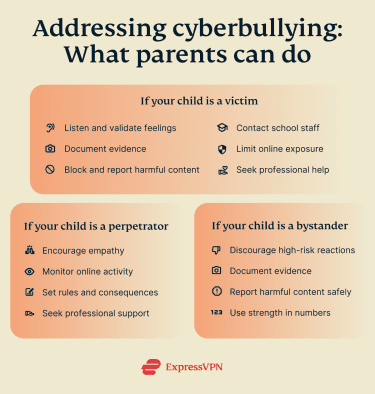
Here are some ways you can de-escalate the situation, provide support, and help them put a stop to what is happening to them.
Help them feel safe
Talking about cyberbullying can be difficult for someone who’s experiencing it. Creating a safe space to talk about it can make the conversation flow a little easier; for instance, you could:
- Approach them calmly, without blame or judgment.
- Let them know they can talk to you about anything, even if it’s embarrassing or upsetting.
- Acknowledge their feelings, even if that’s anger, fear, or sadness.
- Offer them your unconditional support and love.
- Reassure them that they are not at fault for what is happening to them.
Limit their online exposure
If your child is experiencing cyberbullying, you could encourage them to reduce their time on the apps or platforms where the harassment is happening. You can also help them adjust privacy settings to limit who can see their posts, send messages, or comment on their content.
Your child taking a step back from online activity can help them protect their mental health and create space to recover while you work on addressing the situation.
Document everything they experience
Keeping a private record of all cyberbullying incidents is recommended. This can include screenshots of messages, social media posts, emails, or any other evidence of harassment. When recording the evidence, make sure to note the date, time, and context of each incident.
This can help you understand the scope of the problem, and also make it easier to report the harassment should you, as a family, choose to do so.
Teach them how to respond
Whether or not your child should engage with the bully may depend on the specific situation. In most cases, experts advise not responding directly to avoid escalating the conflict.
Bullies are often motivated by a desire for attention and aim to provoke an emotional response from their target. Responding to them can give them exactly what they want, reinforcing and encouraging their behavior.
In cases of cyberbullying especially, exchanges can easily be shared, reposted, or screenshotted, meaning that replying may only draw more attention to the situation and prolong the harassment.
For this reason, rather than retaliating, the safest approach for your child is usually to block the harasser and report the behavior through the appropriate channels.
Help them report and block
Everybody deserves to enjoy their digital life without worrying about harassment. You could help your child take action by using the reporting and blocking features available on social media platforms, messaging apps, and online games. Blocking prevents the bully from contacting them, while reporting alerts the platform so it can investigate and remove harmful content.
Research shows that about 50% of children use prevention tactics such as blocking a screen name, changing passwords, or restricting their buddy list to protect themselves online. These are simple steps that can go a long way when it comes to improving their safety and privacy.
Contact their school
Most schools have strict bullying policies, and these include cyberbullying. Teachers, counselors, and administrators can help monitor the situation, intervene when needed, and provide support.
Talking it over with your child before reaching out can make them feel involved and ready to face the situation. You could explain what information you plan to share, listen to any concerns they may have about privacy or possible backlash, and work together to create a plan that both of you feel comfortable with.
Seek professional help
Cyberbullying can have a serious impact on a child’s emotional well-being. They could suffer from anxiety, depression, or feelings of isolation.
If your child is struggling to cope, consider reaching out to a mental health professional (such as a counselor, therapist, or psychologist) who has experience working with children and teens.
What should I do if my child is bullying others online?
Acknowledging that the problem exists is an important first step, especially since these behaviors can sometimes be easy to miss or mistaken for something less serious.
Here are some steps you can take to address the situation.
Talk to them
It can help to let the child know their actions have been noticed and to invite them to explain exactly what has happened. Maintaining a calm tone can help the conversation flow easier, as reacting with anger may cause them to become defensive or refuse to talk about it.
Encouraging open communication may not be easy, but it could be useful. Understanding the reasons behind the behavior (e.g., are they retaliating against someone? Are they dealing with stress at school or at home?) can make it easier to determine the best way to deal with the situation.
Help them reflect on their behavior
Children may not fully realize the impact their actions can have and may see their own abusive online behavior as harmless fun. So, it can help to explain how cyberbullying can affect the people targeted by it.
A well-known technique emphasized by bullying prevention experts is using guided role-playing and empathy-building conversations to help the child see situations from another person’s perspective.
Monitor and guide their online activity
Parenting resources frequently recommend staying aware of children’s internet usage and online activities. Active parental involvement, like talking with children about their online activities, can prevent children from bullying others online.
However, overly strict monitoring without discussion is less effective and may lead children to hide risky behavior rather than share concerns. So, it’s important to find the right balance.
Set clear rules and limits
Consequences can be set if inappropriate online behavior continues, like temporary loss of device privileges or limits on social media. To prevent any misunderstandings, it’s important to clearly define what is and isn’t acceptable.
Helping the child understand that cyberbullying can have serious consequences in some jurisdictions (from disciplinary actions at school to legal repercussions) can encourage them to make better choices online.
Seek professional support
Persistent bullying behavior can sometimes be linked to underlying issues, such as poor anger regulation, stress, and low self-esteem.
Professional support can help the child develop healthier coping strategies, manage emotions, and understand the impact of their actions. It also gives parents guidance on how to reinforce positive behavior, set appropriate boundaries, and address ongoing challenges without escalating conflict.
How can I empower my child to fight cyberbullying?
Even if your child isn’t directly involved as a victim or perpetrator, witnessing cyberbullying can still affect them negatively. Studies find that up to 90% of teenagers witness cyberbullying, but are hesitant to react because they see little responsibility and for fear of retaliation.
It’s important to help your child navigate situations like these. Learning how to respond in a safe and supportive way can make things easier to manage for both themselves and the victim.
Here are some steps you can take if your child is a bystander to online harassment:
- Discourage high-risk reactions: Confronting the bully directly could put your child at risk or make them a target as well. Encouraging them to find other ways to respond (like offering support to the victim or informing a trusted adult) can help them stay safe while keeping a proactive approach as bystanders. For example, they could send the victim a kind private message or invite them to interact in a different, more positive online space.
- Teach them how to document evidence: You could encourage your child to keep a record of cyberbullying they witness (and only share it with appropriate adults or reporting channels when needed). This can include saving screenshots, messages, or links that show what happened and when it occurred.
- Help them report content: You could show your child how social media’s reporting tools work and explain when they should be used. Reporting cyberbullying can help platforms remove harmful content and prevent further harassment. It’s also a safe way for them to combat cyberbullying, as the platform won’t disclose it was them who made the report.
There’s strength in numbers. Research on bullying and bystander behavior shows that when multiple peers disapprove of the bullying, it can reduce the bully’s influence and make the targeted person feel less isolated.
Confronting the bully directly, even as a group, is rarely advised, but coordinating responses can maximize their effectiveness. For instance, multiple reports on an incident can draw more attention to it and help the issue be addressed faster. Similarly, multiple peers reaching out to the victim (instead of just one) can help them feel supported and less afraid.
Reporting cyberbullying
Since each case of cyberbullying is different, the best approach to reporting may vary depending on the situation.
Here’s everything you need to know about reporting cyberbullying.
To whom should I report cyberbullying?
In some cases, particularly when cyberbullying involves threats, stalking, extortion, or the non-consensual sharing of private images, reporting the incident to law enforcement is important.
Authorities may be able to investigate and take action when someone’s behavior crosses legal boundaries. Many jurisdictions across the globe have enacted strict online safety laws, with consequences ranging from severe fines to criminal charges.
If your child is facing a form of cyberbullying that isn't considered criminal, such as name-calling, social exclusion, or the spreading of rumors, you can report it to their school (assuming the perpetrator and the victim attend the same one).
Additionally, you can always report the cyberbullying to the platform where it’s taking place. Most social networks and apps have reporting tools that allow you to flag hurtful posts, harassing profiles, or threatening messages.
How can I report cyberbullying?
These are the steps to follow when reporting cyberbullying, whether you choose to contact your child’s school, the platform where it occurred, or local authorities.
Reporting to authorities
- Collect and save evidence: Before doing anything else, take screenshots of every instance of cyberbullying; make sure to include usernames and dates.
- Contact local authorities: Call your local police department’s non-emergency number and explain that you want to report cyberbullying. During this process, you’ll likely be asked to provide details of the incident, evidence, and your contact information.
- Get a case number: Make sure to ask for a case number and the contact information of the assigned officer. This will allow you to follow up or provide additional evidence later.
- Follow up on the report: Check in periodically for updates and be ready to provide additional information if the cyberbullying continues.
Reporting to the school
- Review the school’s anti-bullying policy: It’s usually on the school website. This will help you understand how the school defines cyberbullying, who to contact, and what the expected response process is.
- Collect evidence: Gather documentation such as screenshots, messages, usernames, and dates; note if any school‑related contacts were involved in the incident.
- Contact school personnel: Report the incident to the designated staff member (typically a teacher, school counselor, or vice principal) and follow the school’s reporting process. If you’re unsure about who to contact, start with the school office or principal.
- Submit a written report: This will create an official record that the school can reference. The report should include information such as:
- A factual description of what happened
- Dates, times, and locations
- Evidence (e.g., screenshots, messages)
- Names or usernames of those involved
- Request follow‑up information: Ask the school how they plan to investigate the report, what steps they will take, and how you will be informed of actions or outcomes.
Reporting to online platforms
- Collect evidence: Once you’ve identified the platform where the harassment took place, take screenshots or save links of the abusive content.
- Use the platform’s built‑In reporting tools: Open the report function within the app or website and follow the steps. Most platforms allow you to report posts or messages as harassment, abuse, or cyberbullying. Procedures vary by platform, for instance:
- Instagram: Tap the three dots on a post or profile > Report > Choose reason
- Snapchat: Press and hold on chat or snap > More > Report
- TikTok: Tap the share icon on a video > Report > Choose reason
- YouTube: Tap the three dots near the video or comment > Report
- Twitch: User name > Report
- Provide detailed information in the report: When prompted, describe the situation briefly and factually. Include:
- Why the content is abusive or violates rules
- Any evidence you collected (like screenshots or links)
- User names or account details
- Take safety actions within the platform: After reporting, also consider using the platform’s safety features to reduce exposure to ongoing harassment:
- Block the harasser
- Mute comments or messages
- Turn off comments on posts
- Restrict interactions with unknown users
Preventing cyberbullying
As children spend more time online, cyberbullying has become more widespread. Research from the World Health Organization suggests that about one in six children experiences cyberbullying. With this in mind, it’s important to take proactive measures to keep cyberbullying at bay.
How can I keep my child safe from cyberbullying?
While there is never a guarantee that your child won’t experience cyberbullying, these steps can help you reduce the odds of it happening (and provide a safe space for them to seek support if it does happen).
Teach digital skills
Helping your child build strong digital skills can be one of the best ways to lower their risk of cyberbullying. This includes teaching them about online safety, like creating strong passwords, controlling who can see their posts, and guiding them to use social media responsibly without oversharing personal information.
Research indicates that digital literacy can reduce the likelihood of being cyberbullied by up to 73%.
Set privacy settings
Regularly checking and updating your child’s privacy settings helps keep your child’s online activity safer and reduces the risk of cyberbullying. Most apps, social media platforms, and devices have privacy settings that you can configure. For instance, you could make accounts private, restrict who can contact them, and limit location sharing.
A strong parent-child relationship, built on open communication, could also help protect children from both being bullied and engaging in bullying online. Having regular conversations about their digital life (e.g., what apps they use, who they interact with, what content they encounter) can make it easier for your child to turn to you if they face online harassment.
Use online tools for extra safety
Parental control and monitoring apps can help reduce exposure to cyberbullying, inappropriate content, and risky online behavior without being overly invasive. These tools let you block harmful sites, manage screen time, or track online activity (including social media) without checking their device every day.
Many apps offer free basic features, with paid options for deeper insights. When choosing a tool, consider your child’s age, online habits, and digital behavior, since what works for a younger child may not suit a teen.
However, keep in mind that parental control and monitoring tools can be invasive surveillance methods, so it’s important to be transparent about your monitoring. Open communication is often more effective than strict surveillance, especially when it comes to older teens.
How can I talk about cyberbullying with my child?
Cyberbullying and its risks is a topic that may not simply come up in casual conversation. We prepared the following section in the hope that it would help inspire you on how to bring it up. Feel free to draw from the following script to explain to your child what cyberbullying is, how to spot harmful online behaviors, and how to respond safely.
| Have you ever seen someone being treated unfairly or cruelly online? This behavior is similar to in-person bullying, but it happens through digital devices (like smartphones, tablets, or computers) and is called cyberbullying.
Cyberbullying usually involves someone repeatedly using digital platforms to scare, shame, or upset another person. This can include sending mean messages, sharing private information without permission, or posting embarrassing things about somebody. You may have experienced it, witnessed it, or even taken part in harmful online behavior without realizing it. These behaviors often happen in groups, which can make it easier for the people involved to feel less responsible or not fully realize how hurtful their actions are. Here are some examples of risky online actions that can easily escalate into cyberbullying:
These behaviors can be very harmful and difficult to deal with for the person being targeted. If you’ve noticed any of these things happening around you, here are things you can do to help put a stop to it before somebody gets seriously hurt:
Taking these steps can make a real difference and help create a safer online space for everyone. |
Wrap up
Cyberbullying is a serious issue that can affect a child’s mental and physical well-being. Parents play a critical role in reducing its impact by building trust, spotting warning signs early, responding calmly, and reporting incidents with clear evidence.
To stay prepared, you could create or refresh family online rules, review privacy settings on apps and devices, and make a clear plan together in case your child encounters cyberbullying. Taking these steps can help protect your child and give them the confidence to navigate the online world safely.