 Celebrate with up to 80% off
Narrow AI: The tech behind Siri, spam filters, and fraud alerts



Narrow AI is built to do one specific job extremely well. And once you know what to look for, you’ll see it everywhere.
When Netflix queues up your next binge-watch. When your bank pings you about an odd transaction at a gas station you’ve never been to. When your email quietly moves that “You have won” message into your spam folder. That’s all narrow AI doing what it was trained to do, quickly, consistently, and at scale.
What it’s not doing is thinking. It doesn’t understand the world, reflect on decisions, or apply knowledge outside its lane. Each system operates within a tightly defined scope. That’s what makes it powerful, but also what limits it.
What is narrow AI?
Narrow AI, also called weak AI or artificial narrow intelligence (ANI), is designed for a specific task or a small set of closely related ones. Most modern narrow AI learns from data, spotting patterns and using them to make predictions. However, classical chess engines and many rule-based diagnostic systems also qualify, even if they don’t “learn” in the machine learning (ML) sense.
The key word is “narrow.” The best chess AI can crush any human player, but it can’t book you a haircut. Google Maps can find you the fastest route through rush hour, but it can’t spot a phishing email. Each system is built for a purpose, and that purpose is its ceiling.
Here’s the thing, though: inside its domain, narrow AI often blows past human experts. Google DeepMind’s AlphaFold has predicted the 3D structure of over 200 million proteins, essentially every one known to science, work that won its creators a share of the 2024 Nobel Prize in Chemistry. No human biologist, or team of them, could experimentally solve that many structures on anything like the same time scale. What AlphaFold can’t do is write you a poem, hold a conversation about grief, decide what problem is worth solving next, or understand why its own discovery matters outside the narrow task it was built for.
Humans, by contrast, can switch between reading, reasoning, problem-solving, and socializing without needing a software update. Narrow AI can’t do that. Push it outside its training, and it doesn’t adapt well.
Key characteristics of narrow AI
A few things set narrow AI apart from broader ideas of intelligence:
- Task-specific: Each system is designed for one clearly defined job, whether it's recognizing faces, translating German, or flagging fraud. It can’t be repurposed without being retrained from scratch.
- No awareness or understanding: Narrow AI doesn’t “know” what it’s doing in the human sense. When it handles a customer complaint, it isn’t reading it the way you’d read a letter from a friend. It’s following rules and matching statistical relationships between words.
- Data-driven: Most narrow AI learns from examples. Feed it lots of high-quality, representative data, and it performs well. Feed it stale, biased, or thin data, and its outputs wobble.
- Limited adaptability: Small shifts outside its training data can affect its performance. For instance, a fraud model trained on credit card data won't automatically catch insurance fraud, even though they both involve fraud. This is called distribution shift, and it’s one of the hardest problems in deploying ML.
How does narrow AI work?
At a basic level, narrow AI is large-scale pattern recognition driven by algorithms and statistical models. It works through a cycle of processing data and recognizing patterns:
- Data collection: The system is fed huge amounts of data relevant to whatever it’s being asked to do, for example, photos of faces if it’s a facial recognition system or your purchase history if it’s a recommendation engine.
- Training and modeling: ML algorithms, often deep learning or neural networks, process that data to identify the patterns that matter and create mathematical models.
- Inference and prediction: Once it’s trained, the system can take something it’s never seen before and predict an outcome or make a decision, such as whether an email is spam.
- Feedback loops: Most narrow AI doesn’t just get trained once. It keeps learning from new data and user feedback, updating its algorithms to improve accuracy. A spam filter that didn’t do this would become useless very quickly.
Take a system trained to spot diabetic retinopathy in retinal scans, for example. These systems are trained and validated on large datasets of retinal images, some labeled “disease present,” others labeled “disease not present.”
The model works through them and gradually tunes itself until it can pick up on the tiny vascular patterns a specialist would flag. Once trained, it can look at a scan it's never seen and make a call. It's not literally "learning" to look for the same features a doctor does; it's finding statistical patterns in pixels that happen to correlate with those features. The result looks the same, but the process is different.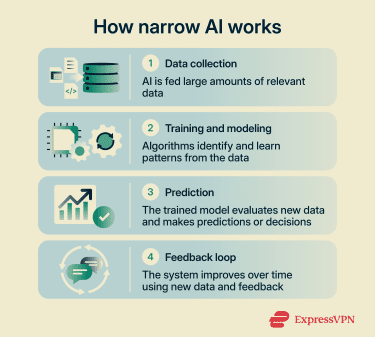
The quality of that output depends on two things: the data the model was trained on and how closely the real world matches that training data. A phishing detector trained mostly on English-language scams from 2019 is going to struggle with a sophisticated AI-generated spear-phishing attempt. That’s why data quality and continuous retraining are essential.
The tech behind narrow AI
A handful of underlying technologies are behind almost every narrow AI system you’ll meet.
Machine learning (ML)
ML is the foundation. It’s the idea that systems can learn from examples rather than being hand-coded for every possible scenario.
A developer doesn't write out every phishing email that's ever been sent; they feed the model tens of thousands of them and let it figure out the signals. Once trained, the model can apply what it's learned to new data, classifying, recommending, and forecasting.
Deep learning
This is a more advanced branch of ML that processes data through layered structures called neural networks, which are computational systems loosely modeled on the way neurons connect in the human brain.
Each layer refines the analysis the previous one passed down, allowing the system to detect increasingly complex patterns. Deep learning is what powers image recognition, voice assistants, and many of the more sophisticated narrow AI applications you interact with today.
Natural language processing
Natural language processing (NLP) is the branch that deals with human language: parsing it, processing it, and generating it. NLP systems are trained on huge volumes of text and speech, learning the statistical relationships between words, phrases, and meaning.
It’s what lets an AI chatbot understand a customer query, a spam filter assess the content of an email, or a voice assistant make sense of you when you talk to it from across the kitchen.
Computer vision
Computer vision lets AI systems interpret visual information from images or video. Like other narrow AI, it’s trained on large labeled datasets and learns to identify patterns, objects, and features.
It's the technology behind facial recognition, medical imaging analysis, the cameras in self-driving cars, and quality control systems on manufacturing lines.
Real-world applications of narrow AI
Narrow AI is widely used across industries. Because it excels at specific functions, it’s often embedded into tools and systems that people use every day.
Healthcare
Models trained on thousands of X-rays, MRIs, and CT scans can flag potential tumors, bleeds, or fractures.
Beyond imaging, narrow AI powers:
- Drug discovery: Drug-discovery companies and researchers increasingly use AI-predicted structures to support target analysis and compound-screening workflows.
- Diagnostic support: Tools that cross-reference symptoms and patient history against large medical databases to surface conditions a clinician might otherwise miss.
- Risk prediction: Models that forecast which patients are likely to be readmitted, deteriorate overnight, or respond well to a given treatment.
Finance
Banks and payment networks rely heavily on narrow AI for fraud detection. When your bank alerts you about a transaction that doesn’t fit your pattern, a narrow AI system flagged it, scanning millions of transactions a second, spotting anomalies far faster than human teams could.
Narrow AI is also used in algorithmic trading. Models range from simple rule-based systems (if X, then buy) to sophisticated models that learn from historical market data and execute trades in milliseconds.
Retail
Retail uses narrow AI on both sides of the counter.
On the customer-facing side, recommendation engines, the systems behind “others also bought” or "you might also like," analyze your browsing and purchase history and match it against patterns against millions of other shoppers to surface products you're more likely to buy. Netflix’s recommendation system accounts for a large share of what people actually watch.
Behind the scenes, narrow AI handles inventory forecasting, dynamic pricing, and supply chain optimization, predicting demand, flagging stock issues, and adjusting prices in real time based on competition and trends.
Physical stores are also increasingly using computer vision. For example, inventory monitoring technology delivers real-time shelf intelligence, helping brands and retailers reduce stockouts and improve on-shelf availability.
Transportation
Navigation apps like Google Maps and Waze use narrow AI to process real-time traffic data and reroute you if a lorry has broken down three junctions ahead. In vehicles, narrow AI powers driver-assistance features such as lane-keeping, automatic emergency braking, and adaptive cruise control, which are now standard on many new vehicles.
Fully autonomous, or self-driving, systems also rely on narrow AI. However, they run a stack of narrow models in parallel: one detects objects, another recognizes lane markings, another predicts what a pedestrian is about to do, and another plans the route.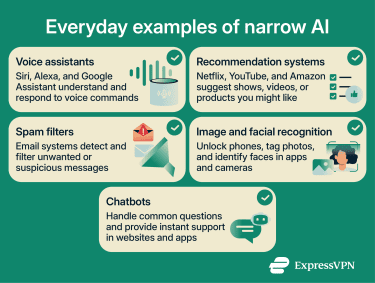
Narrow AI vs. general AI vs. superintelligence
Narrow AI is often compared against two broader categories: general AI and superintelligence. The differences lie in scope, flexibility, and how closely each one resembles human intelligence.
General AI
General AI, or artificial general intelligence (AGI), is AI that can understand, learn, and apply knowledge across a wide range of tasks, much like a human. An AGI could:
- Transfer what it learned in one domain to an entirely different one.
- Reason through problems it has never seen before.
- Adapt to new situations without retraining.
No system today is generally accepted as AGI. Even advanced systems that handle multiple tasks are still narrow AI trained across different domains. But the framing “AGI is purely theoretical” doesn’t really hold up either.
Major labs, such as OpenAI, Anthropic, and DeepMind, are publicly working toward it. Frontier large language models (LLMs) can pass professional exams, write working software, and reason through problems that would have been considered AGI-like a decade ago.
Whether any of them actually are proto-AGI is one of the most contested questions in the field right now.
Superintelligence
Superintelligence is a hypothetical AI that would outperform the best human minds in every area: reasoning, creativity, scientific discovery, and problem-solving. In principle, it would be able to improve its own design, solve problems beyond human comprehension, and operate with a degree of autonomy we’ve never seen.
However, it’s still a theoretical concept, not something that yet exists.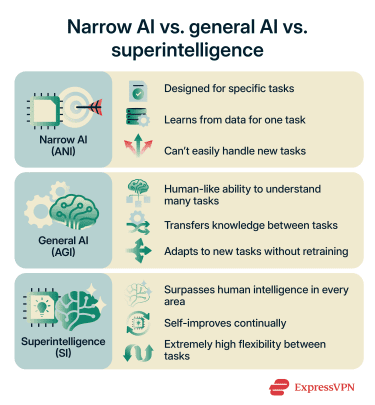
Key advantages and limitations of narrow AI
Narrow AI is powerful, but only within its lane. Like any tool, its value depends entirely on how well it's matched to the task at hand.
What narrow AI does well:
- It’s consistent: A fraud detection system works through millions of transactions at 3am on a Sunday with the same attention it gave the first one. For high-volume repetitive tasks, that consistency is hard to match.
- It scales cheaply: Training a model is expensive. However, running one once it’s trained is much cheaper. This is why narrow AI has spread so quickly. The same AI model can be replicated and run across thousands of instances at the same time and at a fraction of the initial cost.
- It automates repetitive processes: Narrow AI excels at mundane work, such as data entry or manufacturing assembly, allowing humans to focus on more complex, creative tasks.
- It’s testable and benchmarkable: Narrow AI systems can be run against held-out datasets, probed for bias, and monitored once live, which is harder to do with people. That said, peering inside a deep neural network to see why it made a specific call is still a tough problem. Auditing the inputs and outputs isn’t the same as understanding the reasoning in between.
- Within its domain, it can be exceptional: Not just “as good as a human,” but meaningfully better.
Where narrow AI falls down:
- It can’t step outside its task: A fraud model can’t help with translation, and a translation model can’t help with fraud. Every new problem needs a new model or serious retraining.
- It doesn’t reason: Narrow AI spots patterns; it doesn’t understand them. Anything slightly different from its training can lead to serious mistakes, which is why you should be careful when trusting AI-generated content, especially for important decisions.
- It inherits any issues in its training data: Bias, gaps, and outdated information. All of this gets baked into the model and replicated at scale. This has led to growing regulatory scrutiny, including the EU Artificial Intelligence Act (in force since August 2024), which sets binding rules for high-risk AI systems, including those involved in lending, employment, and law enforcement.
- It’s brittle under distribution shift: A model trained in one population or environment often underperforms in a different one. This is one of the hardest problems in deploying ML. Just because it worked in the lab doesn’t mean it’ll work in the field.
The future of narrow AI
Narrow AI isn’t going anywhere. If anything, it’s becoming more important.
More specialized systems
In high-stakes fields where precision matters, such as drug discovery, radiology, and industrial quality control, narrow AI is getting more specialized, not less. Building a dedicated model for a well-defined problem still produces the most reliable results.
At the same time, the opposite is happening. Document summarizers, intent detectors, and content moderators are tasks that used to require a dedicated narrow AI. They’re now increasingly being handled by general-purpose foundation models with a well-crafted prompt.
The future of narrow AI probably involves specialized models where the stakes are high and the task is well-bounded, while general-purpose models handle the long tail of everything else.
Integration with the physical world
Narrow AI is increasingly being bolted onto robots (embodied AI). Numerous companies are building humanoid robots that combine narrow AI models for perception, grasping, and locomotion. Manufacturing lines use computer vision for quality control. Delivery robots navigate pavements using a stack of narrow models working in parallel.
Narrow AI is moving from just processing information to acting on it in the real world.
Connection to AGI research
This is where it all connects up. Many of the techniques that started in narrow AI, including deep learning, reinforcement learning, and self-supervised pretraining, have turned out to be the building blocks that researchers are exploring as potential pathways toward more general intelligence.
This doesn't mean AGI is imminent. However, it does mean that narrow AI and AGI research aren’t separate tracks. They're closely connected, with progress in one area informing the other. But moving from narrow to general intelligence will require major advances, not just scaling up existing systems.
FAQ
Is narrow AI the same as weak AI?
Is ChatGPT a narrow AI?
It’s designed to process and generate text based on patterns in data it was trained on. While it can handle a wide range of language-related tasks, including writing code, summarizing documents, and answering questions across a wide range of topics, it still operates within a defined scope. It doesn’t possess general intelligence or true understanding.
Can narrow AI become general AI?
Can narrow AI perform more than one task?
Genuine multi-task flexibility, where a system transfers learning from one domain to a completely different one, currently remains outside the scope of narrow AI.
Is self-driving technology narrow AI?
How accurate is narrow AI?