
Expressvpn Glossary
Enterprise network

What is an enterprise network?
An enterprise network is the IT infrastructure an organization uses to connect people, devices, and business systems, enabling data to move among users, applications, and services. Its purpose is to support business operations while keeping network traffic controlled, secure, and reliable, rather than treating every device or location as equally trusted by default.
Enterprise networks typically span multiple environments, including on-premises offices and data centers, cloud networks and services, and remote access for hybrid or distributed teams. Common traits include scalability, central management, and segmentation into zones so that different teams, systems, or workloads don't share a single flat network.
How does an enterprise network work?
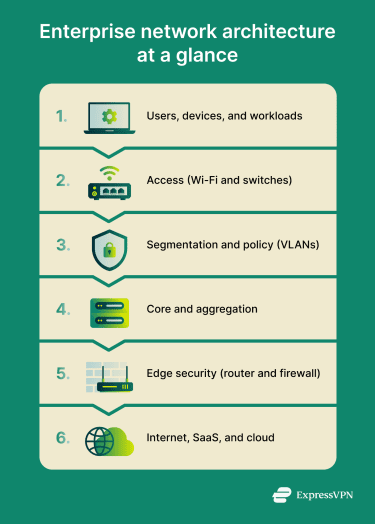
An enterprise network operation depends on several coordinated components:
- Endpoints connect through wired and wireless access: Employee laptops, mobile devices, printers, and servers attach to Ethernet switches or Wi-Fi access points within the organization.
- Switches build local networks and logical segments: Access switches form local area networks (LANs), while virtual LANs (VLANs) separate traffic into distinct logical groups without requiring separate physical cabling.
- Routers link networks and external paths: Routers move traffic between internal subnets, connect branch offices across wide area networks (WANs), and direct traffic to the internet or cloud environments.
- Identity and policy systems govern access decisions: Authentication mechanisms verify users and devices before granting access to specific resources, applying predefined access policies.
- Security systems inspect and monitor traffic: Network security tools analyze traffic flows, enforce filtering rules, and generate logs for oversight and incident response.
Types of enterprise networks
Enterprise environments typically combine multiple network types, each designed for a specific operational scope.
| Type | Primary purpose | Typical environment |
| Campus LAN/WLAN | Provides wired and wireless connectivity within a physical site | Office buildings, headquarters, campuses |
| WAN | Connects multiple geographic locations | Branch offices, regional sites, inter-site links |
| Data center network | Supports internal application and server communication | On-premises data centers |
| Cloud virtual network: virtual private cloud (VPC) and virtual network (VNet) | Enables logically isolated networking in public cloud environments | Amazon Web Services (AWS), Azure, Google Cloud |
| Software-defined wide area network (SD-WAN) | Uses centralized software-defined control to route and optimize WAN traffic across sites and links | Distributed enterprises with branch connectivity |
| Secure Access Service Edge (SASE) architecture | Combines networking and cloud-delivered security services into a unified architecture | Hybrid and cloud-first organizations |
| Software-as-a-Service (SaaS) access | Enables secure access to externally hosted, provider-managed applications | SaaS providers (for example, Microsoft 365 and Salesforce), and internet-based access for users and devices |
Why is an enterprise network important?
- Maintaining availability and performance: Business applications, communication platforms, and internal systems depend on stable, responsive connectivity to operate reliably.
- Protecting sensitive business and customer data: Network controls help limit unauthorized access and reduce exposure of confidential information in transit between users and systems.
- Enforcing consistent security across environments: Organizations often operate across offices, data centers, and cloud platforms. A unified network approach allows policies to be applied consistently rather than separately in each location.
- Supporting compliance and governance requirements: Many industries must demonstrate controlled access, monitoring, and documented safeguards for regulatory or audit purposes.
- Reducing downtime and limiting incident impact: Structured network design and logical separation can help contain disruptions so that a failure or compromise in one area does not affect the entire organization.
Risks and privacy concerns
Enterprise networks can create security and privacy risks when segmentation, configuration, or monitoring is weak. Because they connect many users, systems, and environments, weaknesses in one area can affect the wider organization.
Flat networks can allow lateral movement after a single device is compromised. Misconfigurations, such as incorrect firewall rules or open ports, can unintentionally expose internal services. Weak access controls can enable misuse of compromised credentials, and unpatched devices can harbor vulnerabilities that attackers exploit to gain entry.
Monitoring also raises privacy considerations. Network logging and traffic inspection support oversight and security operations, but extensive monitoring of user activity can affect employee privacy depending on organizational policies, applicable laws, and whether monitoring is necessary and proportionate.
Further reading
- What is Secure Access Service Edge (SASE)?
- What is a site-to-site VPN, and how does it work?
- A complete guide to MPLS VPN services
- Zero-trust network access (ZTNA) explained
- Zero-trust architecture: What it is, how it works, and why it matters