Is Bumble safe for online dating and relationships?


Meeting new people on Bumble can lead to great connections, but it also means trusting strangers with your time, attention, and personal details. Bumble is built with safety in mind and is designed to encourage respectful interactions. But like any dating app, there are privacy concerns, and no security feature can replace your own awareness and boundaries.
This guide explains how safe Bumble is in practice, the main risks to watch for, and how to stay protected while still enjoying yourself.
How safe is Bumble to use?
The safety of using Bumble for online dating depends on both the app's protections and your behavior while using it.
Bumble presents itself as a safety-focused platform that aims to protect its users, but no dating app is completely free of risk. Scammers, abusers, and stalkers can still misuse the platform despite safeguards in place. Bumble's women-first design, community guidelines, and built-in verification and moderation tools are intended to reduce harassment, impersonation, and unwanted contact. That said, as with any large online service, there's still a small risk of data exposure if Bumble or one of its partners is ever compromised.
What makes Bumble different from other dating apps?
Whitney Wolfe Herd founded Bumble after leaving Tinder, where she was cofounder and served as Vice President of Marketing. She created Buble as a dating app that aims to give women more control. From the start, Bumble positioned itself as a women-empowerment-driven alternative designed to shift how conversations begin and how people interact online.
Bumble's defining feature is that in heterosexual matches, women send the first message, giving them control over whether a conversation ever starts. This core idea has evolved to include greater flexibility: women can also choose an "Opening Move" prompt that lets men respond first while still keeping the woman in control of the exchange's direction and tone.
This approach sets Bumble apart from many other dating apps, where women often receive a higher volume of unsolicited or aggressive messages.
Beyond its pro-woman branding, Bumble aims to promote real engagement with its time-limited matches: a match disappears if no one sends a message within 24 hours.
Besides, it offers several connection modes in a single app: Bumble Date for romantic connections and Bumble For Friends (BFF) for platonic friendships.
Does the “women first” design actually improve safety?
Bumble initially required women to send the first message in heterosexual matches, giving them 24 hours to decide whether to continue the match. This was intended to reduce aggressive openers and shift some of the pressure women often face on dating apps. Today, Bumble still offers this structure, but it also includes "Opening Moves," a feature that lets women set a prompt and allow men to respond first.
However, while these conversational tools can help shape safer interactions, they're not a complete solution. Some risks, such as impersonation, off-app behavior, or how your data is handled, exist regardless of who sends the first message. Bumble still collects personal information through your profile, app activity, and device permissions, like all major dating apps.
Is Bumble For Friends (BFF) safe for friendships?
BFF is set up as a friendship-only space, with Community Guidelines that require members to be 18 or older, use authentic profiles with a clear face photo, and respect the platonic intent of the mode.
Safety is enforced through human moderators and automated systems that can remove content, issue warnings, or ban accounts across Bumble’s apps, including for serious misconduct that happens off-platform.
That makes BFF more structured than many social spaces, but you’re still dealing with strangers, so the usual precautions still apply. Be careful of sharing personal details, block or report anyone who crosses your boundaries, and keep first meetups in public, safe settings.
Understanding the risks of using Bumble
Before you start chatting, it’s important to know the most common threats you might encounter on Bumble and what early warning signs to watch for. Here are the major risks and how they typically unfold.
Common scams you might encounter on Bumble
Law enforcement and consumer protection agencies warn that online dating scams are on the rise and often start on legitimate platforms, like Bumble.
For example, the FBI notes that scammers create large numbers of fake profiles across major dating sites and apps, build what appears to be a genuine romantic connection, and then exploit that trust for financial gain.
1. The “pig butchering” investment scam
Pig butchering scams mix romance and investment fraud. A scammer builds a long, intense chat relationship, then steers you toward “exclusive” investment platforms, often in cryptocurrency.
Warning signs include:
- Quick attempts to shift the chat to WhatsApp, Telegram, or other text messaging apps.
- Rapid emotional intensity and talk of soulmates (commonly referred to as “love bombing”).
- Promises of huge, guaranteed returns.
- Screenshots of trading apps or wallets you can’t independently verify.
- Pressure to “invest more” after a small early “win.”
If any Bumble match offers to “teach you how to invest” or claims to have secret access to special trading platforms, treat that as a scam, report the user, and cut off contact.
2. Military romance scams
Military romance scams use stolen photos and fake identities to impersonate deployed soldiers. The story usually builds up to money requests tied to hardship or blocked access to funds.
Red flags to watch for:
- Claims of deployment to war zones or secret missions.
- Ongoing excuses for why they can’t video chat.
- Urgent requests for money, gift cards, or cryptocurrency, claiming it's "just until they get home."
- Strong push to move conversations away from Bumble quickly.
If someone claiming to be in the military can’t verify their identity on secure video and links romance with financial requests, you’re likely dealing with a standard online dating scam.
3. The classic catfish
Catfishing means using fake photos, names, or life details to gain your trust. Not every catfish is after money; some seek attention, control, or emotional manipulation.
Common signs to be aware of:
- Very polished, model-like photos with no real bio.
- Only one or two photos and vague profile details.
- Refusal to use live video after days of chatting.
- Stories that don’t match what you find on their other social profiles.
Learn more: Find out more details about online dating scams and typical things to watch out for.
Can Bumble track your location or IP address?
If you allow location access on your device, Bumble uses your phone’s GPS (and related signals like nearby Wi-Fi access points) to determine your real-time location and show you people nearby. You can update the city and hometown fields on your profile, but you can’t freely “spoof” your general location unless you use paid Travel Mode, which lets you set yourself to another city while you’re away or before you travel.
Bumble collects your IP address whenever you use the app or website. For example, when you contact Customer Support, they log your IP address, along with your email address and the details of your request, and keep those records for several years.
In practice, Bumble can link your account activity to both your approximate physical location (via GPS/Wi-Fi) and your network location (via IP address), even if you don’t share your exact address in your profile or conversations.
How Bumble protects its users
Bumble includes several tools designed to help you stay safer while dating online. These features can’t eliminate all risks, but they do make it easier to verify matches, manage your privacy, and avoid common threats.
1. Identity verification and the blue checkmark
Bumble’s Photo Verification is one of its main tools against impersonation. It asks you for a real-time selfie in a specific pose shown by the app, which Bumble's team then checks against your profile photos. If they match, you get a blue checkmark showing your photos have been verified. You can also request that a match verify their photos, but verification isn’t required to use Bumble.
Bumble also offers optional ID verification, where you upload a government ID and a selfie to get an extra badge. At the time of writing, this feature is only available in selected countries (including the U.S. and the U.K.) and is not required to use the app.
These checks help you confirm that the person you’re talking to matches the photos and documents they provided. They don’t guarantee that someone is safe, respectful, or honest; they simply reduce the risk of obvious impersonation and fake personas.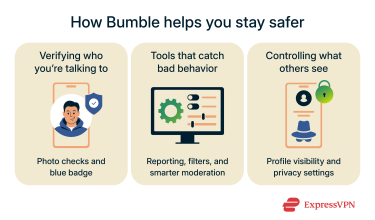
2. In-app safety tools and moderation
Bumble has built several practical safety tools into the app, including:
- Block and report options in every chat.
- Warning pop-ups if your message might break the guidelines.
- Private Detector blurs suspected nude images and lets you decide whether to view or delete them.
- Deception Detector is an AI-powered tool backed by human moderators that works behind the scenes to flag many scam or fake accounts before you see them.
- In-app voice and video calls, so you can talk to a match without sharing your phone number or social accounts.
- The Safety and Wellbeing center and Bumble Safety Handbook, which explain consent, boundaries, red flags, and how reporting works in detail.
- A global team working 24/7 to monitor for fake profiles, spam, and any activity that breaks its Community Guidelines.
3. Privacy controls and profile management
Bumble also offers controls that shape how visible you are and how much personal information you share. Depending on your plan and region, these can include:
- Incognito Mode and Snooze Mode, which limit who can see your profile or let you pause it for a while
- Choices about which photos, work details, education, hometown, and gender information appear on your profile.
- Location settings on your phone that let you share location only while the app is in use.
Strong privacy on dating apps starts with what you leave out. Avoid adding your surname, exact workplace, or public social handles to your profile, and keep anything that could easily identify your home, routine, or close contacts out of photos and prompts.
If you ever decide the app isn’t right for you, deleting your Bumble account and data is always an option for extra peace of mind.
Practical tips for staying safe on Bumble
How to spot fake or suspicious profiles
You can train yourself to spot risky profiles before you ever match or message. That habit is one of the strongest online dating safety tools you have. Watch for patterns like:
- No verification badge on profiles that look unusually polished or “too perfect” is a signal to look more closely. However, it’s worth noting that photo verification on Bumble is optional and not required.
- Bios that are incredibly vague, full of generic quotes, or inconsistent with the photos.
- Location that suddenly jumps from one country or city to another with no explanation.
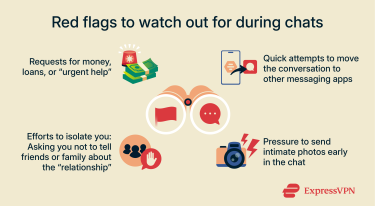
Once you’re chatting, keep an eye on behavior, too. When something feels wrong, trust that feeling. Block and report suspicious users inside the app so the safety team can investigate. Reporting suspicious users protects you and strengthens online dating safety for others who might encounter the same account.
Meeting in real life: Staying safe before, during, and after a date
If you choose to meet someone you connected with on a dating app, a few digital-privacy steps can help protect your identity and personal information before you transition from online to offline communication.
Before the date
- Avoid sharing sensitive information such as your home address, workplace, daily routine, or other identifying details.
- Double-check that the person you’re meeting matches the verified photos and any social profiles you’ve already seen to avoid impersonation.
- Use Bumble’s Share Date feature or your phone’s location sharing to let a trusted person know your whereabouts.
During the date
- Keep your phone charged and accessible.
- Avoid showing personal information on your phone, such as your home screen widgets, calendar events, or work emails.
- Maintain control of your accounts and devices; don’t hand your phone to someone you’ve just met.
After the date
- If something feels unsafe, unmatch, block, or report the profile.
- Review what you’ve shared on the date and/or in previous chats, and tighten your app permissions or privacy settings if needed.
Learn more: Read our detailed guide on how to protect your privacy and stay secure when using dating apps.
Should you use a VPN for extra privacy on Bumble?
A virtual private network (VPN) can make using Bumble more private on the network side, but it doesn’t stop Bumble itself from collecting data about you. Think of it as a useful extra security layer, not a fix for how the app works.
What a VPN can do:
- Encrypt your internet traffic so people on the same network or your internet service provider (ISP) can’t easily see what apps you’re using.
- Reduce the risk of man-in-the-middle (MITM) attacks on public Wi-Fi.
- Hide your real IP address from Bumble, but this does not hide your GPS-based location.
What it can’t do:
- Stop Bumble from seeing your account, matches, messages, and in-app activity.
- Prevent Bumble from using your device’s GPS/Wi-Fi data to see your location if you’ve granted that permission.
- Change Bumble’s own data collection or sharing practices.
To protect your privacy and account, use a strong, unique password, enable two-factor authentication (2FA), limit personal details in your profile, and tighten data-sharing settings. A VPN complements these practices for network-level security and privacy but shouldn’t be your only safety measure.
Will a VPN affect Bumble’s functionality?
It can. Because a VPN changes your IP address and sometimes your apparent region, it may cause issues with loading or connecting and confuse Bumble’s location checks or distance filters.
If Bumble starts behaving oddly (wrong location, loading profile issues), test it without the VPN. If things return to normal, you’ve likely found the cause.
Is Bumble safer than other dating apps?
You can enjoy a safer Bumble experience by using verification tools, keeping chats on the app at first, watching for red flags, avoiding oversharing, and approaching in-person meetings with caution. But “safer” doesn’t equal “safe.” Online dating risks don’t disappear on any platform; they might just become more manageable.
Here’s a quick comparison of Bumble vs. other dating apps:
| Bumble | Tinder | Hinge | OkCupid | |
| Safety tools and moderation | Safety and Wellbeing Centre, Private Detector (blurs explicit images), clear anti-harassment rules, reporting/blocking options | Safety Center, Tinder prompts: Does This Bother You (DTBY) and Are You Sure (AYS) to avoid potentially offensive messaging, date check-ins | Safety guides, “We Met” feedback for post-date reports, standard blocking/reporting tools | Reporting and content rules, selfie checks in some regions, but users still report many scams and bots |
| Verification and identity checks | Photo Verification with blue check, ID verification in select regions | Face verification and optional background checks via a partner service (U.S. only) | Basic profile checks and reports; selfie verification is being rolled out to some regions | Rolling out photo verification in multiple markets; longer profiles can help spot inconsistencies |
| Privacy and data collection | Collects precise location data through GPS and network signals; users can manage visibility through app permissions and settings | Stores extensive user data, like photos, messages, preferences, and behavioral signals, similar to other major dating apps | Sits in the same parent group as Tinder, profiling supports matches but deepens data stores | Stores politics, religion, sexuality, and personality data |
FAQ: Common questions about Bumble safety
Is it safe to give out my phone number on Bumble?
It’s generally safer not to share your phone number early on Bumble. Once someone has it, they can contact you outside the app, even if you unmatch them. It’s safer to use in-app voice or video calls until you’ve built enough trust to feel comfortable sharing more.
Can I use Bumble anonymously?
Not fully. Bumble always shows a profile with photos, age, and general location, and the app still knows who you are via your account details and device. You can stay semi-anonymous by avoiding your surname, exact workplace, and public social handles, and by using visibility tools like Snooze or Incognito Mode. Still, you can’t use Bumble in a truly anonymous way.
What should I do if I encounter a scam or harassment on Bumble?
If someone harasses or scams you on Bumble, stop engaging immediately, then use the in-app tools to unmatch, block, and report them with as much detail as you can. If money was involved, or you feel threatened or unsafe, keep any evidence you have (screenshots, dates, usernames) and contact local law enforcement as well. You can also reach out to Bumble’s support team for additional help.
Are all Bumble users verified?
Not all Bumble users are verified. Photo and ID verification are optional features, so you’ll see a mix of profiles with a blue checkmark (verified) and profiles without it.
Is Bumble safe for LGBTQ+ users?
Bumble includes features designed to support Lesbian, Gay, Bisexual, Transgender, and Queer (LGBTQ+) users, such as expanded gender identity options, same-gender matching, and clear rules banning hate speech and harassment. The app has collaborated with organizations such as the Gay and Lesbian Alliance Against Defamation (GLAAD) to make its platform more inclusive and respectful of diverse identities.
That said, no dating app can guarantee a completely safe experience. LGBTQ+ users (like anyone else) may still encounter bias or inappropriate behavior from individuals. Using Bumble’s tools to report or block such users, and being mindful of what personal information you share publicly, can help you stay safer while meeting people on the app.
Take the first step to protect yourself online. Try ExpressVPN risk-free.
Get ExpressVPN